“For me, it has long been clear:
Women rule our world!
And, in my opinion, this is wonderful.”
Gabriel García Márquez
Writer, Nobel Prize laureate
For a long time, we were imposed images of Ukrainian women as suffering. All the literary and historical heroines we got used to from school were expected to suffer from a cruel fate, serfdom, corvée labor, men, or simply tradition. Even the beginning of many Ukrainian songs, “Oi,…”, was perceived as a lament of suffering, although historians know the Old East Slavic greeting “Hoi, my prince” or “Hoi esi”, and the verb hoitysia means to heal (a wound), to recover, to live, to be healthy.
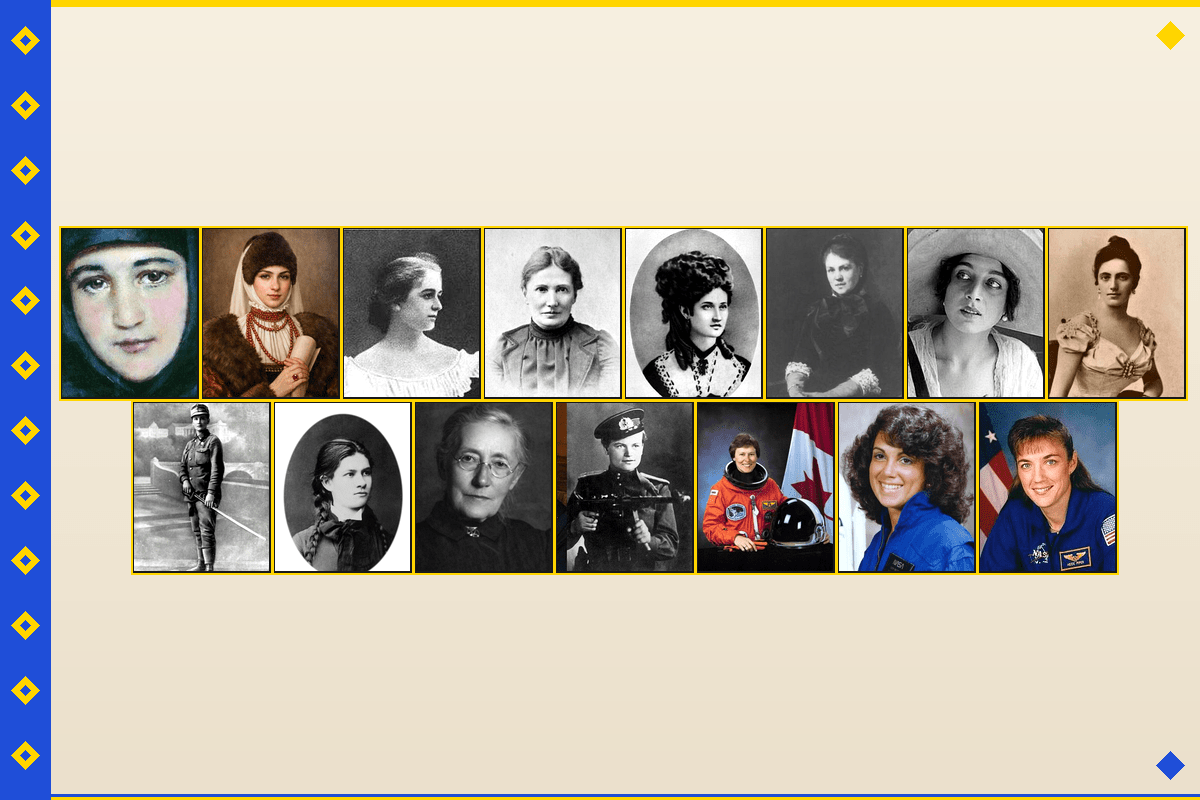
Let us look more closely at the real stories of Ukrainian women! We will see a different palette — persistent work, a thirst for life, dramas, intrigues, the ability to adapt reality to one’s desires, a drive for development, and a tendency toward volunteering. Anything except suffering. If there is a goal in life, there is no time for tears.
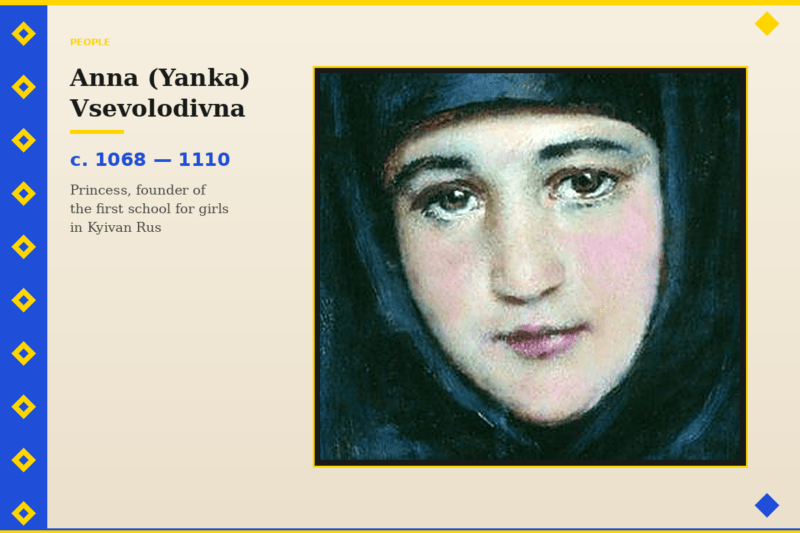
Anna (Yanka) Vsevolodivna
Daughter of the great Kyiv prince Vsevolod, granddaughter of Yaroslav the Wise, and great-granddaughter of Volodymyr the Great.
Founder of the first school for girls in Kyivan Rus.
Another intelligent woman in the dynasty of great Kyiv princes, who found a way to realize her ambitions in the turbulent Middle Ages. In her youth, Anna was engaged to the Byzantine prince Constantine Doukas. She arrived in the Byzantine Empire, but the wedding never took place. The groom was either killed or forcibly tonsured as a monk to remove him from the struggle for the throne. The fact is that Anna returned home and took monastic vows. If you think that life ended for women at that point, you are mistaken.
“Everything is just beginning”, the princess decided, and began to actively master her new status. Of course, not every nun could expect any kind of career advancement, but Anna Vsevolodivna was intelligent and ambitious, and her father was the Grand Prince of Kyiv. This significantly increased her room for maneuver. In 1086, her father founded the St. Andrew’s (Yanchyn) Monastery in Kyiv, where Anna Vsevolodivna became the first abbess. She opened the first school for girls in Kyivan Rus, and one of the first in Europe, at the monastery, where they were taught literacy, folk medicine, singing, and sewing.
In addition, Anna Vsevolodivna took an active part in the ecclesiastical and political life of Rus’. For example, after the death of the Kyiv Metropolitan John II, she led an embassy to Constantinople and brought the new Metropolitan John III to Kyiv. Legends circulated among the people about Anna Vsevolodivna’s extraordinary skill in healing the sick. In short, her life was rich and eventful, and she enjoyed considerable popularity. After her death, the Orthodox Church canonized her as a saint.
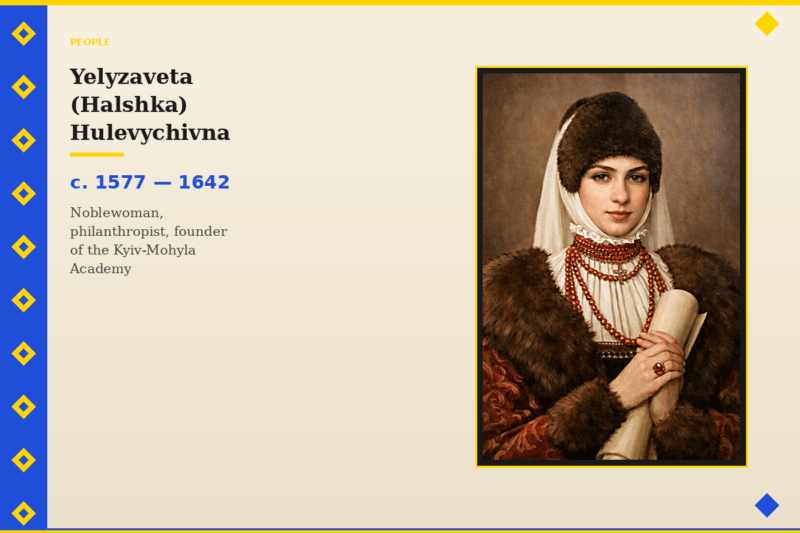
Yelyzaveta (Halshka) Hulevychivna
A noblewoman and patron, to whom we owe the existence of the Kyiv-Mohyla Academy.
Psychologists assure us that to feel happy, a person must not only do for themselves but also for others. Ukrainian women were actively engaged in volunteering long before it became mainstream. That is why we owe them so much, including educational institutions.
Yelyzaveta Hulevychivna was an ordinary Ukrainian noblewoman from a wealthy Volhynian family. Thanks to her grandfather, she received an excellent education and developed a useful habit of supporting brotherhood schools for future generations. At the age of 19, she became the wife of Khrystofor Potii, the son of Metropolitan Ipatii Potii of the Ukrainian Greek Catholic Church. The story of this marriage was almost Shakespearean: two feuding families (defenders of Orthodoxy and Catholicism), children in love, a marriage against parental opposition, an escape from home, and the birth of a beloved daughter. But the newlyweds did not enjoy family happiness for long — her husband died a few years later.
For the second time, Yelyzaveta married a wealthy Kyiv nobleman, Stepan Lozka. She moved to Kyiv and became closely involved with the Kyiv Brotherhood. After a fire in 1614 destroyed several buildings at the Epiphany Monastery, including a school, Yelyzaveta voluntarily donated her estate and lands in Kyiv to establish a new monastery, hospital, and school for the children of nobles and townspeople. This marked the beginning of the Kyiv Orthodox Brotherhood School, which later developed into the Kyiv-Mohyla Collegium and Academy (today — the National University “Kyiv-Mohyla Academy”). Throughout her life, she also donated funds not only to Kyiv schools but also to other brotherhood schools.
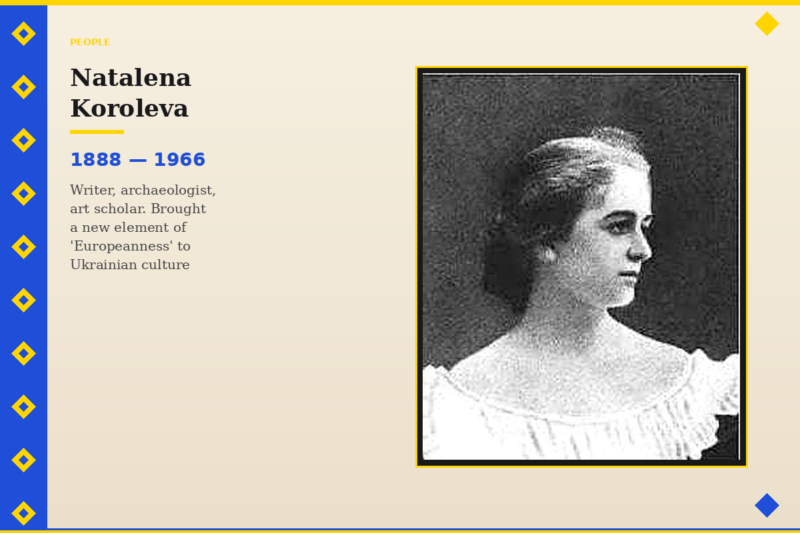
Natalena Koroleva
Through her work, she introduced a new element of “European-ness”, intellectualism, and philosophical depth into Ukrainian culture.
She was born in 1888 in the Monastery of San Pedro de Cardeña near Burgos in northern Spain. Her full name, according to the old Spanish tradition, was Carmen-Alfonsa-Fernanda-Estrella-Natalena. Her mother, Mari-Clara de Castro Lacerda, died during childbirth. The girl was raised by her grandmother, Teofila, from the ancient Lithuanian-Ukrainian Domontovych family in the village of Velyki Birky in Volhynia. After her grandmother’s death, Natalena was taken to Spain.
The child spent twelve years in the Notre-Dame de Sion monastery in the French Pyrenees. In the autumn of 1904, the 16-year-old girl first arrived in Kyiv. She impressed everyone who knew her with her knowledge of history, archaeology, philosophy, medicine, and music theory. In addition, she spoke not only French but also Polish, Spanish, Arabic, and Italian — while still remembering Ukrainian from childhood.
She later studied at the Kyiv Institute for Noble Maidens. In Kyiv, she studied music with Mykola Lysenko. As a keepsake, he gave her a musical miniature, “The Star with the Moon,” inscribed “To my student.”
Later came a decisive refusal of a lucrative marriage, studies at the Archaeological Institute of St. Petersburg, and a doctorate in archaeology for her work on Lithuanian antiquities. She then studied Egyptology while also attending the Imperial Academy of Arts, graduating as a “free artist” and holding exhibitions in St. Petersburg and Warsaw.
She joined the French Mikhailovsky Theatre in St. Petersburg and later signed a contract with the Paris Théâtre Gymnase, which toured the Russian capital, Western Europe (Spain, France, Italy), and the Middle East. She also participated in archaeological excavations in Pompeii and Egypt.
Her first literary works, written in French, began appearing in Parisian journals in 1909. The First World War found N. Koroleva in Kyiv. During the war, she joined the Red Cross and served for nearly three years at the front in the Russian army as a doctor. She was awarded the Soldier’s Cross “For Bravery”, was wounded three times, and suffered typhus and several cases of pneumonia. During the Ukrainian national liberation struggle of 1917–1920, she worked in the UNR Ministry of Foreign Affairs, and later emigrated to Czechoslovakia, where she taught in Prague. There, she married Vasyl Korolev-Staryi, who inspired Natalena to write in Ukrainian.
Her first work, “Sin”, was published in the Ukrainian weekly “Volia” (Vienna, 1921). In the mid-1930s and early 1940s, her books brought her wide recognition and popularity: the collection of legends “In the Days of Yore”, the novellas “1313” and “Without Roots”, the story collection “A Different World”, the novellas “Ancestor”, “The Shadow’s Dream”, and “Old Kyiv Legends” — a richly intricate weaving of Slavic, Scythian, ancient Greek, early Christian, and even Scandinavian myths, legends, and tales. After the war, her novella “Quid est veritas?” was published in Chicago. Through her work, Natalena Koroleva brought a new element of “European-ness”, intellectualism, and philosophical depth into Ukrainian culture.
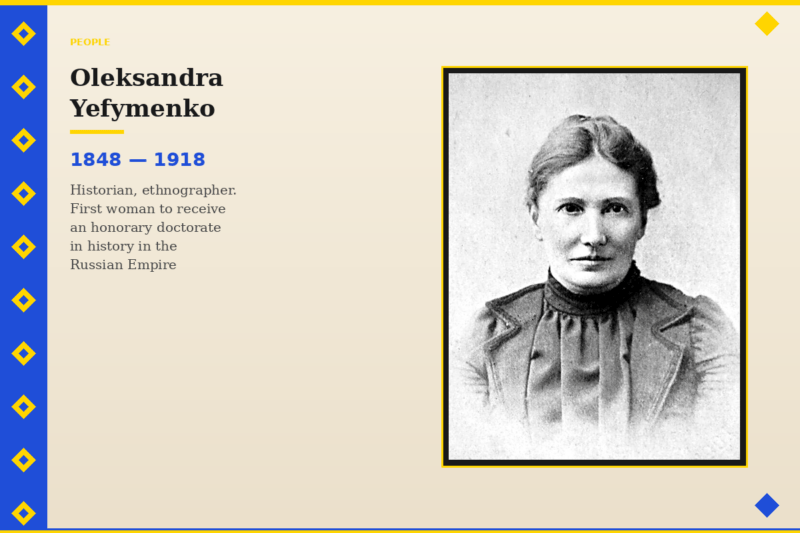
Oleksandra Yefymenko
Historian and ethnographer. The first woman to receive an honorary Doctor of History degree in the Russian Empire.
Education is a special topic for Ukrainian women. The drive for development and self-identification cannot be hidden, even if one tries very hard. Oleksandra Yefymenko could not hide it. One might say she was teaching Ukrainians the history of Ukraine long before we understood why it mattered.
She was born into a family of civil servants in the Arkhangelsk Governorate. She married the Ukrainian historian, ethnographer, and revolutionary activist Petro Yefymenko, moved to Chernihiv, and later to Kharkiv. Together with her husband, she organized a historical circle that eventually became the Kharkiv school of Ukrainian historiography.
She studied the history of Ukraine and was a student of Kyiv University professor Volodymyr Antonovych. She demonstrated strong civic engagement — defending the Ukrainian language, condemning the Valuev Circular and the Ems Ukaz, advocating for women’s equal rights, lecturing at the Kharkiv Library and at the Bestuzhev Higher Women’s Courses in Saint Petersburg, and writing the “History of the Ukrainian People”… In short, she contributed greatly to education and the advancement of knowledge.
In 1910, Kharkiv University — despite public opinion that predictably did not support the decision — awarded Oleksandra Yefymenko the honorary Doctor of History degree. Thus, she became the first woman in the Russian Empire to receive such recognition at a time when women were still not allowed to study at universities.
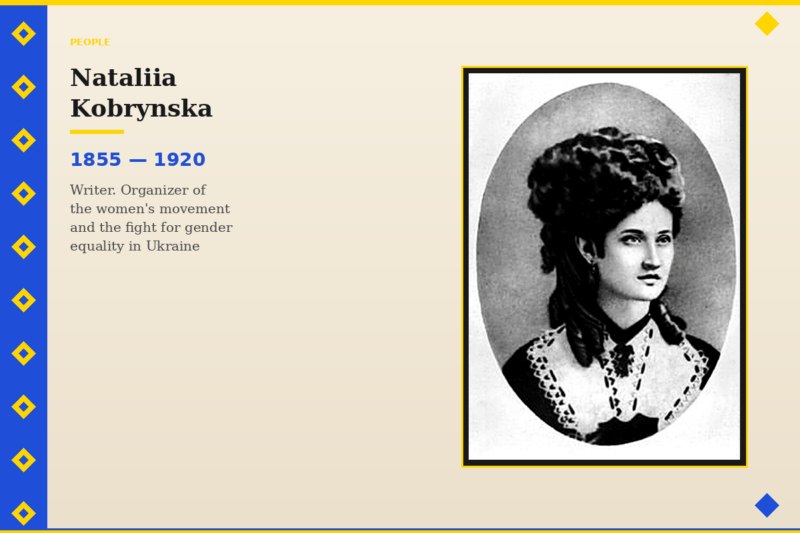
Nataliia Kobrynska
Writer. Organizer of the women’s movement and the struggle for gender equality in Ukraine.
Kobrynska was a young woman with an excellent education. One day, she came across “Letters from Kraków” by Professor Józef Kremer — a small Polish book reviewing a French treatise on the inequality of women and men. Raised in a family that treated women with particular respect and dignity, Kobrynska was deeply offended by the idea that anyone could consider women inferior to men. She was so affected that she made it her main mission to promote feminist ideas through literary and journalistic work.
Her immediate circle did not understand this approach to life and considered her a strange eccentric. Almost the only person who supported the young activist was her husband, Teofil Kobrynsky. However, her most active work began after his death.
Kobrynska advocated for women’s and men’s equality in the Austro-Hungarian Empire, submitted petitions requesting women’s access to university education, and, in 1884, founded the first Ukrainian women’s organization in Stanislaviv, called the “Society of Ruthenian Women”. She established close cooperation with Ukrainian women in the Russian Empire. She founded the first Ukrainian women’s organization. In essence, modern Ukrainian women’s journalism began with her — something like today’s “Vogue”, but even better. The publication “Pershyi Vinok” (“The First Garland”), created under Kobrynska’s initiative, laid the foundations for women-edited magazines. Thanks to her efforts, Ukrainian women’s organizations began operating in Lviv, Chernivtsi, Rivne, and other cities of Western Ukraine.
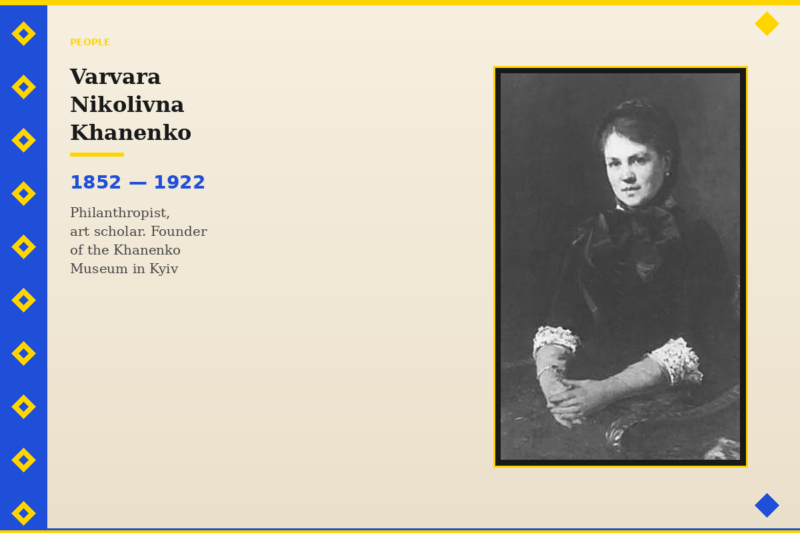
Varvara Nikolivna Khanenko
Patron of the arts, art historian
What made Varvara Khanenko possible in our history? What shaped her historical choice and gave her strength? These questions require reflection and answers not only because of the great debt of memory and respect toward the Khanenkos, but also for our own self-awareness — a “healing” of ourselves through recalling the paths we Ukrainians have already walked. A restoration of our history of dignity.
What is the greatest merit of Varvara Khanenko, the uniqueness of her historical role? It lies in the choice she made during the difficult years of 1917–1919. In the great sacrifice called the “Khanenko Museum in Kyiv”.
In the spring of 1917, at the very beginning of a major historical rupture, her beloved husband Bohdan Khanenko died, and Varvara Khanenko, at the age of 65, was left alone. One of the finest private collections of world art in the Russian Empire came under her sole control. According to their shared plan, confirmed in her husband’s will, she was to complete the collection’s organization, create a museum, and donate it to the people of Kyiv.
History, however, prepared a far more difficult trial for this elderly woman. Varvara Khanenko was perhaps the only owner of a vast private collection in Kyiv who faced such a harsh choice: to save herself and their “child” — the priceless collection of art and antiquities — and leave turbulent Kyiv for Europe, where she could honorably establish the “Das Khanenko Museum” or “Le Musée fondé par B. & W. Khanenko”, or to take the risk of staying and creating the Khanenko Museum here, in Kyiv.
It was a choice between preserving life and preserving the meaning of life. Between external wholeness and internal integrity. The latter required a sacrifice far greater than anything Varvara Khanenko had ever been prepared for — a sacrifice to which her entire cultural upbringing had led her: to give the collection to the city. Now it was a matter of sacrificing herself — her safety, her life. The result of her decision, her great act, we can all see today, and many of us have visited and deeply love it. Varvara had no biological children, but she gained hundreds of thousands of grateful grandchildren and great-grandchildren, and their number continues to grow.
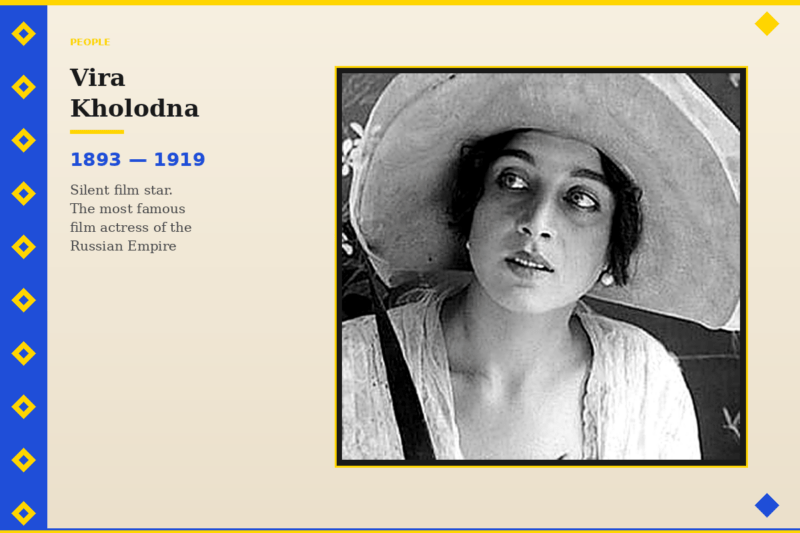
Vera Kholodna
Star of silent cinema, the most famous film actress of the Russian Empire.
She was born in Poltava under the name Vera Levchenko. She married the lawyer Volodymyr Kholodny and took his surname. Vera Kholodna’s acting career lasted less than five years, but during that time she appeared in dozens of films (dramas, melodramas, short films) and became more than just a sex symbol of her era. After the release of her first film, she began receiving letters from unknown men confessing their love. Some even wrote that they would commit suicide because of their unrequited feelings for her.
Thus began a bright and turbulent life story in the style of “The Great Gatsby”. Even the outbreak of the First World War could not interrupt it. She continued to act and captivate audiences not through powerful dramatic talent, but through boundless femininity. Between film projects, she participated in charity concerts and fundraising events for soldiers and their families. Changes in political regimes did not affect her popularity; she remained admired by all. Vera Kholodna’s participation in a film meant there would be no organizational problems, such as shortages of film stock.
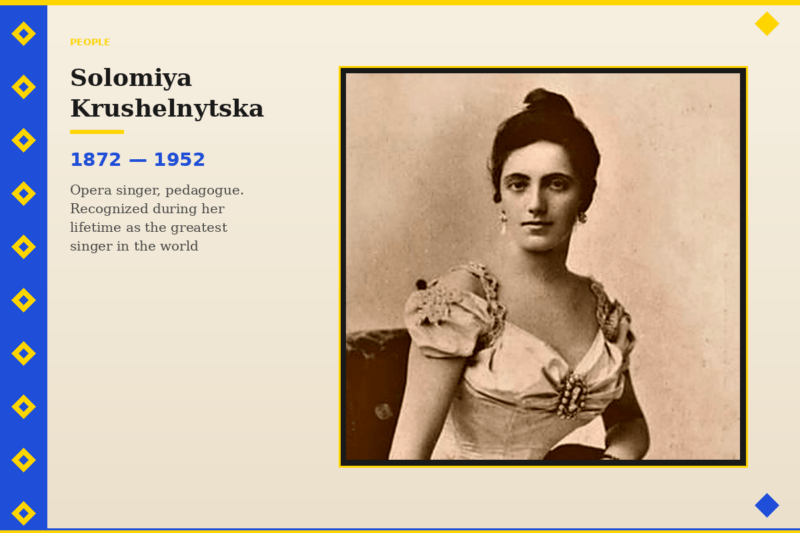
Solomiya Krushelnytska
Opera singer, teacher. Recognized during her lifetime as the world’s greatest singer.
The exceptional talent of opera singer Solomiya Krushelnytska transformed her life into a grand, refined romance with music. She began singing at a young age. She studied at the Ternopil School of the “Friends of Music” society. She received her basic musical education at the Ternopil Classical Gymnasium, where she took exams externally. At the age of eleven, she gave her first public performance in the choir of the Ukrainian society “Ruska Besida” in Ternopil.
Immediately after graduating from the Lviv Conservatory, she made her debut on the stage of the Lviv City Theater. Thus began her journey of conquering the world with an extraordinary voice. Even after achieving global fame, she regularly returned home and gave concerts almost every year in Lviv, Stanyslaviv, Ternopil, Berezhany, Kolomyia, Stryi, Zbarazh, and Chernivtsi. She maintained close contacts with Ivan Franko, Mykhailo Pavlyk, Olha Kobylianska, and Mykola Lysenko, who dedicated three romances to her.
In 1899, Krushelnytska performed before the family of Russian Tsar Nicholas II. She concluded her performance with Ukrainian folk songs. When the emperor asked in which language she had sung, she replied with dignity: “These are songs of my people, the Ukrainian people”.
At the beginning of the 20th century, Solomiya Krushelnytska continued to tour extensively around the world, and in every country, journalists competed in praising her in their articles. Her close friend, the Argentine pianist Negrita de Piazzini, recalled that the great singer “was as simple in her private life as she was great on stage”.
In August 1939, a year after her husband’s death, Solomiya left Viareggio and went to Lviv to visit relatives. She never returned to Italy. The Soviet authorities nationalized Krushelnytska’s house in Lviv, leaving her only a second-floor apartment.
She was not allowed to leave the USSR and was not granted Soviet citizenship. Eventually, she did receive citizenship, essentially in exchange for transferring her villa in Viareggio to the USSR. She worked at the vocal department of the Lviv State Conservatory — Soviet bureaucrats for a long time “could not find” her 1893 diploma, without which the world-famous singer was not allowed to work at the conservatory. Only in the last months of her life was Solomiya Krushelnytska awarded the title of professor and Honored Artist of the Ukrainian SSR.
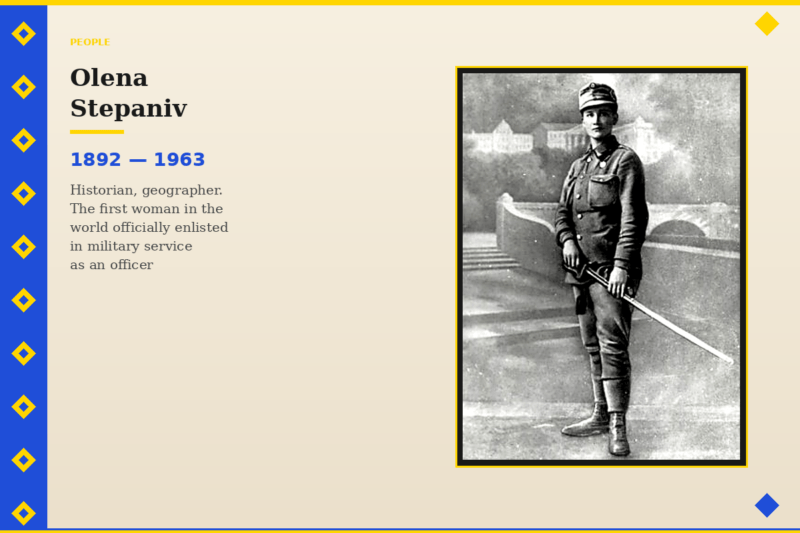
Olena Stepaniv
Historian, geographer, public and military figure; the first woman in the world to be officially enrolled in military service as an officer, a “chetar” of the Ukrainian Galician Army.
Today, the participation of Ukrainian women in the war for independence is not always perceived unambiguously. A hundred years ago, it was not perceived at all, because a woman in the role of a combat officer was simply unimaginable. Olena Stepaniv paid no attention to that. That is why her story alone could inspire several fascinating films.
As soon as the young student at Lviv University and Plast member Stepaniv heard about the formation of the Ukrainian Sich Riflemen, she immediately asked to be assigned to the provisioning commission. There she was assigned to household and clerical tasks. This did not satisfy her. She found a man’s uniform, tailored it to her size, and went to the best photo studio to take a photo for her military identification. When she came to pick up the photo, the police tried to arrest her on suspicion of espionage. She was saved from imprisonment only by the intervention of her colleague, the well-known Volodymyr Starosolskyi. Eventually, Olena achieved her goal and joined the army.
She distinguished herself during the battles for Makivka. In one of the fights, her commander was killed, and Olena had to make decisions on her own and lead her company. After this, she was promoted to the rank of “chorunzhy”. This became an unprecedented example for the entire world.
During the battle near Lysovychi, she was captured by Russian forces. She became one of the most famous heroines in the press of the time. First, a female officer was something unheard of. Second, she repeatedly and proudly confirmed her reputation as a “separatist Mazepist”, who voluntarily went to fight against the “Moskals”. At the same time, she behaved with such dignity that even the Russian press showed a degree of sympathy toward her.
Stepaniv returned home only two years later, after being exchanged for a Russian intelligence agent. After returning to Galicia, she rejoined the Ukrainian Sich Riflemen and, after a brief break following her dismissal from the Austrian army, took part in the Polish–Ukrainian war as a soldier of the Ukrainian Galician Army (UGA).
Later, Olena served as press secretary of the State Secretariat of Foreign Affairs of the West Ukrainian People’s Republic (ZUNR) and the Ministry of Foreign Affairs of the Ukrainian People’s Republic (UNR) in Kamianets-Podilskyi. She studied at the University of Vienna, where she defended her doctoral dissertation. She taught history and geography at the Lviv Basilian Sisters Gymnasium and at the secret Ukrainian University in Lviv. After World War II, she continued her teaching and academic work. In 1949, she was again taken prisoner by Soviet authorities on charges of anti-Soviet propaganda and sent to Mordovian labor camps, from which she returned in 1956 at the age of 72.
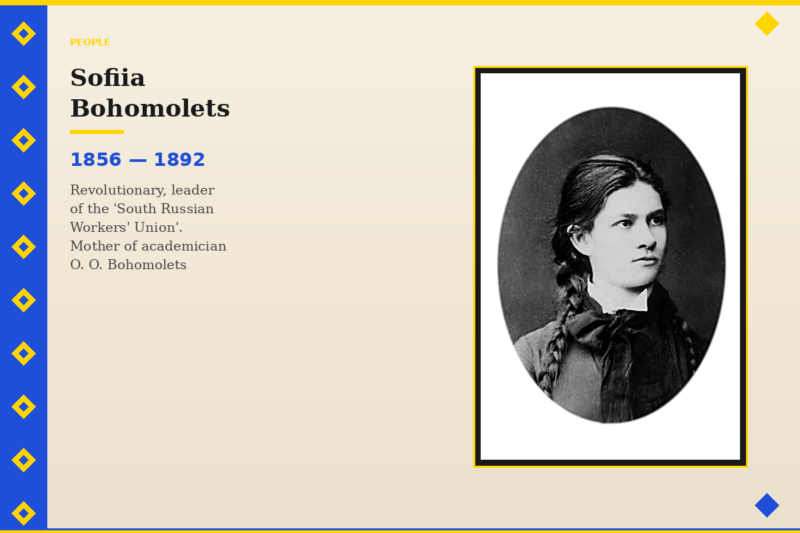
Sofiia Bohomolets
Mother of academician Oleksandr Bohomolets, Sofiia Bohomolets, was a well-known revolutionary and one of the leaders of the populist organization “South Russian Workers’ Union”. Two weeks after the birth of her son, she was sentenced to death, later commuted to 19 years of hard labor.
In the harsh conditions of imprisonment, Sofiia Bohomolets amazed even experienced and cynical guards with her resilience. She spoke directly to the governor-general, telling him exactly what she thought in harsh terms, defended her fellow prisoners, and never renounced a single word she had spoken in the name of the cause she believed in. Neither punishment cells nor solitary confinement, where she sometimes spent months, broke her spirit. However, her health deteriorated, and she developed tuberculosis, from which she later died. Through her own life, Sofiia Bohomolets “taught” her son, the future brilliant scientist, never to give up, especially when serving and living for the good of others.
Oleksandr saw his mother only once in his life, when, with the help of Leo Tolstoy, his father was allowed to visit Sofiia in Siberia… Before her death, Sofiia Bohomolets gave her son a handwritten, personally bound copy of Taras Shevchenko’s “Kobzar” and asked her relatives not to interfere with her husband and son giving away the land she had inherited from her father. Later, the academician recalled: “Ten years of a true penal regime could not break the will of this very fragile woman, did not destroy her faith in the victory of socialism, and did not cause a single moment of regret for a life devoted to an idea. She died undefeated”.
Her husband (Oleksandr’s father), Oleksandr Mykhailovych Bohomolets, was the son of Mykhailo Fedorovych Bohomolets — a zemstvo doctor and descendant of a judicial official who was also repeatedly arrested for cooperation with the Narodnaya Volya movement. Oleksandr Bohomolets carried through his entire life the idea that “everyone, in their own field, must strive to live not for themselves, but for people, for the Motherland”. He devoted his life to humanity, seeking ways to make human life of 125–150 years free of disease. His motto was: “Life is not everything; the main thing is service to people”.
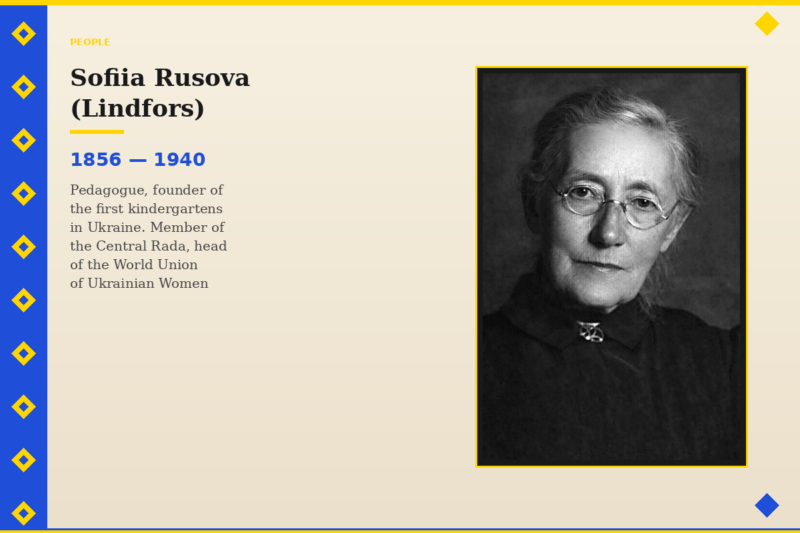
Sofiia Rusova (Lindfors)
Educator, founder of the principles of national-oriented education.
Sofiia Rusova dedicated her life to the struggle for a strong Ukrainian nation. She became actively involved at the age of 15, when she and her sister founded the first kindergarten in Ukraine (1871), designed for only 20 children. It was attended by children of the intelligentsia of that time, heirs of noble families. Among the pupils were two children from the Starytskyi family. Over time, the sisters’ kindergarten grew into one of the centers of Ukrainian national culture. In the evenings, the kindergarten premises often hosted a folk drama circle. Sometimes productions for amateur actors were directed by Mykhailo Starytskyi and Pavlo Chubynskyi.
She created the first opera in the Ukrainian language — Mykola Lysenko’s “Christmas Night” — and the opera “Koza-Dereza”, the first opera work for children. The significance of the uncensored two-volume edition of “Kobzar” published in Prague (1876) for the development of Ukrainian culture is difficult to overestimate. Rusova also played an important role as a member of the Central Rada. A person of both musical and pedagogical talent, she became a devoted activist whose radical views led to 20 years of surveillance and multiple arrests.
At the beginning of the last century, she developed the concept of national-oriented education. Rusova emphasized that a nation is formed in the cradle. In her view, only in one’s native land, surrounded by native nature and within the linguistic environment of one’s people, can a truly conscious individual and citizen be formed. National art is one of the primary factors shaping worldview and artistic sensibility in early childhood.
She worked in public organizations in Odesa, Kharkiv, and Kyiv, headed the “National Committee of Teachers” and other associations. While living in Odesa for four years, Rusova classified Ukrainian literary works and also spent some time in an Odesa prison. The Central Rada had only two female deputies, one of whom was Sofiia Rusova. She was also a co-founder of the Ukrainian women’s movement, headed the Ukrainian National Women’s Council, and served as president of the World Union of Ukrainian Women. In mid-February 1933, the Ukrainian National Women’s Council in Prague issued an appeal to all the peoples of the world. In it, Ukrainian women called for attention to the catastrophic situation of Ukrainians and for assistance through the Red Cross. The appeal was signed by the chair of the National Council of Women of Ukraine, Professor Sofiia Rusova.
Given that Sofiia was born into a family where her father was a Swede, Lindfors, and her mother a Frenchwoman, and that she was orphaned early in childhood, the meaning of her statement about a nation beginning in the cradle was one she experienced personally.
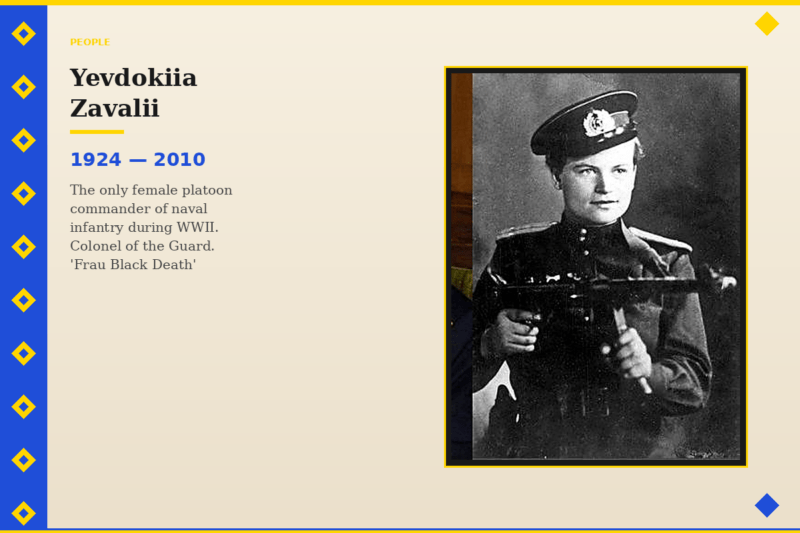
Yevdokia Zavalii
The only female platoon commander of marine infantry during the Second World War, Guard Colonel.
This is a classic story of a girl who dreamed of fighting. She disguised herself as a boy, added several years to her real age, and at 17 ended up at the front. She was assigned to an airborne brigade. She kept her secret for eight months. After capturing a German officer, she was transferred to a reconnaissance unit, which she soon commanded. In one battle, the platoon commander was killed, and she led everyone into the attack. She was wounded in that battle, and in the hospital, her secret was revealed — “Yevdokym”, who had been fighting alongside the paratroopers for eight months, was actually a girl.
In 1943, she was sent to a six-month junior commanders’ course and, as a junior lieutenant, assigned as a platoon commander in the 83rd Marine Brigade. Earning the soldiers’ respect took time, but once earned, it was absolute. During one battle, a young, inexperienced soldier tried to hide in a shell crater, but Yevdokia forced him back into the attack. In response, he insulted her and still went forward. After the battle formation, he repeated the behavior. Yevdokia went to the medical unit and, upon returning, asked the senior officer to read aloud a note she had been given there. It stated: “This certifies that Lieutenant Zavalii Yevdokia Mykolaivna is chaste”. After that, the soldiers’ respect for her became virtually unshakable.
As a platoon commander, she took part in the liberation of Sevastopol, the assault on Sapun Hill (for which she received the Order of the Patriotic War, 1st class), fought in battles for Balaklava, Sukharna Holivka, and Kerch, crossed the Dniester estuary, liberated Bessarabia, fought in the liberation of Taman, Tuapse, and Novorossiysk, landed in Constanța (Romania), Varna and Burgas (Bulgaria), and Yugoslavia. Among German troops, she was known as “Frau Black Death”.
After the war, she moved to Kyiv and worked as a grocery store director. In Kyiv, she met her future husband: he tried to save her from an attack by robbers, but she repelled them faster with a shot from a captured pistol than he managed to reach her. She later married him and gave birth to two children.
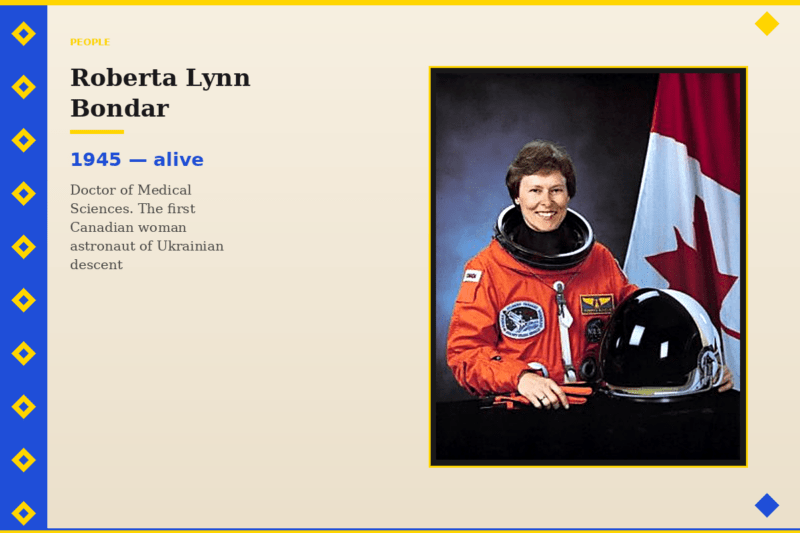
Roberta Lynn Bondar
Doctor of Medical Sciences, the first Canadian woman astronaut of Ukrainian origin
Roberta Lynn Bondar (born December 4, 1945, Sault Ste. Marie, Ontario, Canada) is the first Canadian woman astronaut and the first neurologist to go into space. She was born into a family of ethnic Ukrainians originally from Hороденка (Horodenka), Ivano-Frankivsk region. She speaks Ukrainian fluently. From childhood, she dreamed of becoming a teacher. Her father set up a home laboratory for her, where Roberta conducted various biological experiments. At school, she developed a passion for astronomy: she observed stars and read both scientific and science fiction literature.
She studied in Western Ontario (1969) and completed her doctorate at the University of Toronto (medical dissertation). Bondar is a neuroscientist. After deciding to become an astronaut, she learned to fly a plane. She worked at McMaster University Medical School in Hamilton, the University of Western Ontario, and Boston Medical Center (USA). She was selected for the astronaut corps (1984) and trained for spaceflight at NASA (USA). From January 22–30, 1992, R. L. Bondar became the first Canadian woman astronaut.
She is the recipient of numerous government awards, a member of the Royal Society of Canada, and an honorary doctor of more than 20 universities in the USA and Canada. She is a member of the Ukrainian Canadian Congress. Bondar’s name is included in the Canadian Hall of Fame. Several schools and a science-technical club in Ukraine are named after her, and a park in her hometown bears her name. The main-belt asteroid 13693 Bondar, discovered on October 4, 1997, also carries her name. On the 25th anniversary of her space mission, Canada issued a commemorative silver coin worth 25 dollars.
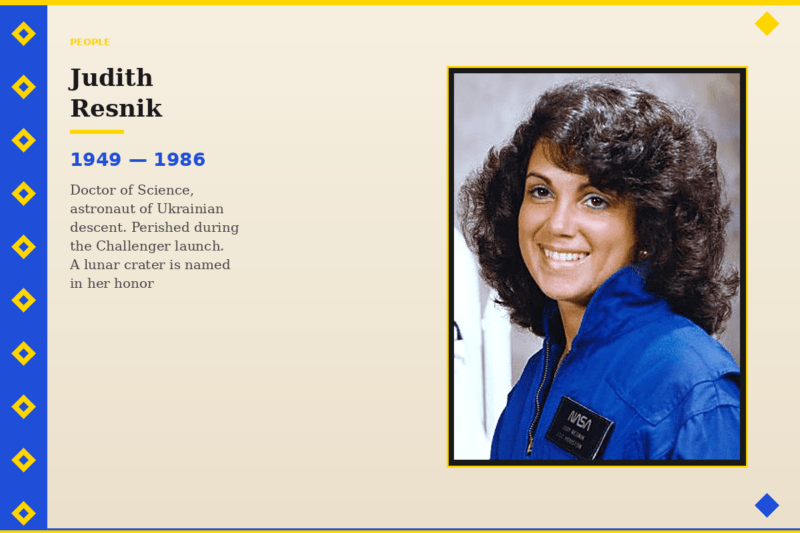
Judith Resnik
Doctor of Science, astronaut
Judith Arlene Resnik’s parents came from Ukraine, from Kyiv. She studied at Carnegie Mellon University (1970) and the University of Maryland (PhD). She was selected as a spaceflight candidate in January 1978. She first flew into space from August 30 to September 5, 1984. She spent 144 hours and 57 minutes in flight, orbiting Earth 96 times.
She died during the launch of mission STS-51-L when she was flying for the second time. On January 28, 1986, the Space Shuttle Challenger exploded 73 seconds after liftoff, resulting in the death of all seven crew members. She was a member of numerous scientific societies and received NASA medals and other honors. A crater on the far side of the Moon and an asteroid are named after Judith Resnik.
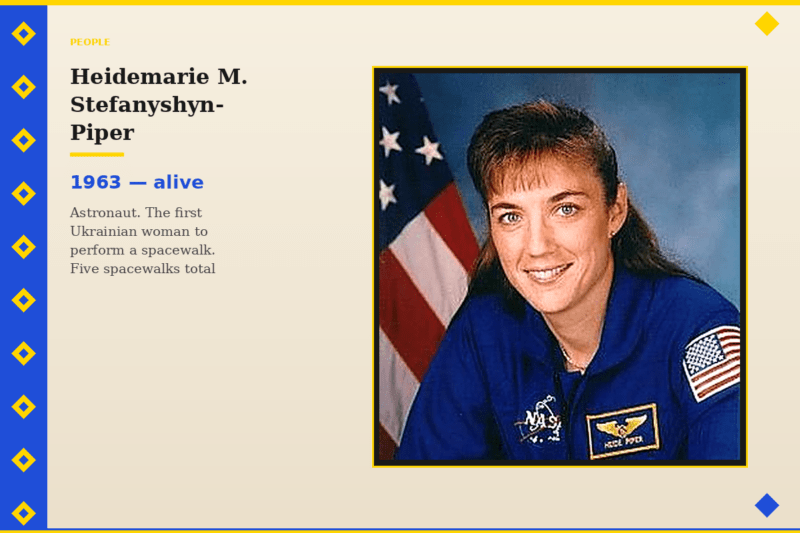
Heidemarie Martha Stefanyshyn-Piper
Astronaut. The first Ukrainian woman to perform a spacewalk. She completed five spacewalks in total!
Heidemarie Martha Stefanyshyn-Piper is an American astronaut of Ukrainian origin who accomplished what many men only dream of. She has completed two space missions during which she performed five spacewalks. Heidemarie became the third woman of Ukrainian heritage to travel into space. Before her, this achievement was reached by Judith Arlene Resnik from the USA and Roberta Lynn Bondar from Canada.
Her father was taken for forced labor to Nazi Germany during the Second World War. After the war ended, he chose not to return to his homeland, fearing repression from the Soviet government. He married a German woman, and together they emigrated to the United States, where Heidemarie was born.
The family preserved many Ukrainian traditions, attended a Ukrainian church, and Heidemarie studied at a Ukrainian Saturday school and was a member of the “Plast” scouting organization. Even after marrying an American, Glenn Piper, she insisted on keeping her double surname, Stefanyshyn-Piper, and named her son Michael after her father. She continues to emphasize her Ukrainian identity.
Heidemarie chose a rather unconventional path for a woman. She earned a master’s degree in mechanical engineering from the Massachusetts Institute of Technology. She studied on a U.S. Navy scholarship, which required her to sign a service contract with the Navy. From June 1985, she trained at the Naval School of Diving and Salvage.
In 2006, she flew her first space mission aboard the Space Shuttle “Atlantis”. The STS-115 mission aimed to resume the construction of the International Space Station (ISS), which had been suspended after the “Columbia” disaster. Heidemarie performed two spacewalks totaling 12 hours and 8 minutes, during which she installed truss segments with solar panels on the station.
She became the 447th person in space, the 43rd woman to fly in space, and the 8th woman to perform a spacewalk. Her second mission took place in 2008 aboard the Space Shuttle “Endeavor” (STS-126). During this mission, she performed three spacewalks totaling 20 hours and 34 minutes, contributing to the expansion of the ISS and installation of new equipment.
In 2009, Heidemarie left NASA’s astronaut corps to return to service in the U.S. Navy. She commanded the Carderock Naval Surface Warfare Center division in Maryland for two years. She holds the rank of U.S. Navy captain, equivalent to a captain 1st rank in Ukraine.

Article from the archive of the NGO “International Humanitarian Association ‘We Are Ukrainians’”